A Special Project: A Transit Map as a Personal Diary
Special Personal Project
Disclaimer
This isn't just a concept, but a whole story of the development of the most important project in my life. Essentially, the following is a very detailed description of my hobby. It determined the type of education I want to pursue and what I enjoy doing most.
While choosing between architecture, cartography, transport geography, and urban studies, I took preparatory courses at the Moscow Architectural Institute, enrolled at the Moscow State University of Geodesy, Cartography, and Cartography, dropped out, completed a bachelor's degree at the Faculty of Geography at Moscow State University, and a master's degree at the HSE Graduate School of Urbanism. And yet, I still haven't decided completely which topic is closer to me.
While choosing between architecture, cartography, transport geography, and urban studies, I took preparatory courses at the Moscow Architectural Institute, enrolled at the Moscow State University of Geodesy, Cartography, and Cartography, dropped out, completed a bachelor's degree at the Faculty of Geography at Moscow State University, and a master's degree at the HSE Graduate School of Urbanism. And yet, I still haven't decided completely which topic is closer to me.
If you are a recruiter
The story on this page describes my skills and interests the best. Conceptually. But please, do not rush to judge the project's design at the beginning of the story: I was still in high school at that time, and it was largely through this project that I learned to work independently in a graphics editor.
Conclusion of the story is the most recent version of the project, designed in the way I do it today.
The story on this page describes my skills and interests the best. Conceptually. But please, do not rush to judge the project's design at the beginning of the story: I was still in high school at that time, and it was largely through this project that I learned to work independently in a graphics editor.
Conclusion of the story is the most recent version of the project, designed in the way I do it today.
If you are here out of curiosity
I haveve warned you: the text here is just as important as the images.
Enjoy your immersion.
I haveve warned you: the text here is just as important as the images.
Enjoy your immersion.
Part One
Mestetsk
2015
I don't particularly like the dubious connotations of the phrase "fantasy map," but this project is exactly that. By this, I mean a street map and a collection of transit maps for a fictitious city.
It might sound even stranger, but I've been involved with such "projects" since early childhood, discovering atlases of Moscow transit maps (and collecting similar ones for other cities). I would linger with admiration and genuine interest in trolleybus route maps, which used to be posted only on the back of the driver's cab inside the trolleybus itself. It was this mode of transportation that I gravitated toward the most, eventually becoming part of a community that now yearns for the days when trolleybuses were ubiquitous in Moscow.
It might sound even stranger, but I've been involved with such "projects" since early childhood, discovering atlases of Moscow transit maps (and collecting similar ones for other cities). I would linger with admiration and genuine interest in trolleybus route maps, which used to be posted only on the back of the driver's cab inside the trolleybus itself. It was this mode of transportation that I gravitated toward the most, eventually becoming part of a community that now yearns for the days when trolleybuses were ubiquitous in Moscow.
Once I'd pushed the handwritten version of the maps to what seemed like their limits, I grew bored: I was tired of drawing identical lines with a ruler and writing names in my tiny, type-printed handwriting. At the same time, I wanted to create more (and I positioned my hobby as creativity).
It was 2014 and a fashion for urban design was gradually taking shape, with navigation design and transport branding becoming one of its niches. In Russia, Moscow, as always, was a pioneer in this field, and the experience of redesigning the Moscow metro navigation system was incredibly inspiring.
I lacked the tools to do things "like them," so I took an Adobe Illustrator course.
It was 2014 and a fashion for urban design was gradually taking shape, with navigation design and transport branding becoming one of its niches. In Russia, Moscow, as always, was a pioneer in this field, and the experience of redesigning the Moscow metro navigation system was incredibly inspiring.
I lacked the tools to do things "like them," so I took an Adobe Illustrator course.
Mestetsk was the working title of my first personal project, drawn in a graphics editor. My youthful maximalism took over, and the project immediately assumed enormous proportions. I had little understanding of artboard formats, so the canvas with the map in the editor took up almost the entire working area (meaning, if printed, it would hypothetically be the size of a huge five-meter banner).
The concept echoed the main ideas from the handwritten projects: since transportation cannot exist without streets, a road network is first formed (naturally, in a radial-ring configuration, since my imagination was severely limited by my love of the ideal shape of Moscow's ring roads). This is the most important, but also the longest and most uninteresting stage.
After that, a series of appendices were being created for the map, which is what started it all: a metro map, commuter train maps, and, if I'm patient enough and don't want to start over, even ground transit routes maps (meaning bus, trolleybus and tram routes separately). The graphics editor allowed me to do the latter as a separate layer on top of the street grid, just like in those same atlases from which I drew my inspiration.
The concept echoed the main ideas from the handwritten projects: since transportation cannot exist without streets, a road network is first formed (naturally, in a radial-ring configuration, since my imagination was severely limited by my love of the ideal shape of Moscow's ring roads). This is the most important, but also the longest and most uninteresting stage.
After that, a series of appendices were being created for the map, which is what started it all: a metro map, commuter train maps, and, if I'm patient enough and don't want to start over, even ground transit routes maps (meaning bus, trolleybus and tram routes separately). The graphics editor allowed me to do the latter as a separate layer on top of the street grid, just like in those same atlases from which I drew my inspiration.
Mestetsk (and rebirth of this project a year later – see below) is the only project among my works 'for the drawer' that has a hypothetical geographic location. According to the legend (which was emerged without much support, as that wasn't the point for me), I decided to choose a location on the Msta River (hence the project's/city's name), approximately halfway along the Moscow-St. Petersburg railway. From an economic, geographic and real-world perspective, this is an extremely dubious idea, but I've ignored that point as at that time I was yet no geographer.
The images above show an OpenStreetMap tile, over which I began drawing a very smooth street grid with perfect circles and straight highways, ignoring the terrain features. The main reasons for this were my lack of experience working with the pen tool in Illustrator and my unfamiliarity with GIS at that moment. To export data from OSM, I, then a ninth-grader with no understanding of GIS, had to tinker and find Maperitive software myself, which allowed for exporting OSM data fragment by fragment. The mosaic of exported rasters became the basis for both the street grid and a large series of toponyms in places where I lacked the imagination to come up with street names.
The images above show an OpenStreetMap tile, over which I began drawing a very smooth street grid with perfect circles and straight highways, ignoring the terrain features. The main reasons for this were my lack of experience working with the pen tool in Illustrator and my unfamiliarity with GIS at that moment. To export data from OSM, I, then a ninth-grader with no understanding of GIS, had to tinker and find Maperitive software myself, which allowed for exporting OSM data fragment by fragment. The mosaic of exported rasters became the basis for both the street grid and a large series of toponyms in places where I lacked the imagination to come up with street names.

Toponyms are a whole other story.
This is another major area of urban studies (or, more accurately, cultural geography), which has interested me from time to time and, in the traditional sense, resulted in the topic of my master's thesis. Just like maps, I've been fascinated since childhood not only by wayfinding with names and the origins of certain names, but also, for example, by public transportation stop announcements. A whole art form in itself!
Even before the first digital version of the map was made, I thought that the most of toponyms on my "personal" map could reflect my life, or rather, my surroundings. Streets in cities are often named after prominent figures, and if I express myself in such an unusual way, I can name objects after loved ones, friends, teachers, and other people who have influenced my life.
This is another major area of urban studies (or, more accurately, cultural geography), which has interested me from time to time and, in the traditional sense, resulted in the topic of my master's thesis. Just like maps, I've been fascinated since childhood not only by wayfinding with names and the origins of certain names, but also, for example, by public transportation stop announcements. A whole art form in itself!
Even before the first digital version of the map was made, I thought that the most of toponyms on my "personal" map could reflect my life, or rather, my surroundings. Streets in cities are often named after prominent figures, and if I express myself in such an unusual way, I can name objects after loved ones, friends, teachers, and other people who have influenced my life.
When I was creating the Mestetsk map, I thought it would be cool to mix names of my own origin with local, real-life toponyms. So, I was again trying to synthesize the mechanisms of geographic name formation, as in Moscow. There, for example, was a village called Troparyovo, and later a district and metro station of the same name appeared in its place, because there seemed to be a shortage of prominent names for the area. Another approach is to use the names of cities, regions, and natural features, both in Russia and abroad. It's preferable for streets with such names to be located on the same side of the city center as the feature that gives its name (e. g., Black Sea Drive will be in the southern part of the city, while St Petersburg Road - in the north).
I used this logic to create the toponymic sequence on my map. For objective reasons of privacy, I don't include tiles with names related to people close to me in my portfolio, and I illustrate the story with neutral names.
I used this logic to create the toponymic sequence on my map. For objective reasons of privacy, I don't include tiles with names related to people close to me in my portfolio, and I illustrate the story with neutral names.
I like shapeless Russian names or those that sound unusual. The toponymy around Mstinsky Most (a village that, in the project, falls into the center of the hypothetical city) exceeded my expectations. There are many obscure, funny-sounding, or mysterious names. In fact, I personally think that from the outside, these names look the same as the names on my "childish" maps - sometimes they have very strange letter combinations (Súyska, Pozharyé, Grébla).
As for the names honoring loved ones, they turned out to be logically distributed among different parts of the city. This system was already established when I was creating paper maps earlier. Just as there are whole neighbourhoods (street clusters) in Moscow named after academics or military personnel, on my map, the names of friends and, for example, teachers, turned out to be distributed among different parts of the city.
An extreme audacity, consistent with the idea that such a map serves as a kind of personal diary, is to vary the types of objects in honour of acquaintances depending on the degree of closeness with them and the nature of the relationship in general.
As for the names honoring loved ones, they turned out to be logically distributed among different parts of the city. This system was already established when I was creating paper maps earlier. Just as there are whole neighbourhoods (street clusters) in Moscow named after academics or military personnel, on my map, the names of friends and, for example, teachers, turned out to be distributed among different parts of the city.
An extreme audacity, consistent with the idea that such a map serves as a kind of personal diary, is to vary the types of objects in honour of acquaintances depending on the degree of closeness with them and the nature of the relationship in general.
I always provide transliterations of all names because I believe my work should be clear for any viewer. I've learned a lot about transliteration rules over the years, and the initial versions of the map are debatable; for example, "й" letter can be transliterated as "j", when it is often "y" in other sources.
There are also counter-principles that I learned early on: some transliterated words are homonyms to real English words (they sound the same, but mean something different), and the spelling should be changed to avoid mispronunciation by foreigners ("поле" [ru: field] = "поле" [en: pole]; you can put a hyphen between syllables or insert the letter "u": "po-le" or "poule" for correct pronunciation).
For empirical reasons, which I later supported with the concept of a "hierarchy of landmarks" in my master's thesis, the closest people are immortalized in the names of metro stations. The opposite are small passages and alleys.
At this initial stage, it’s too early to evaluate my design skills, although at the time of creation, it seemed that the product turned out to be incredibly high-quality, at minimum because of its multi-layered nature.
There are also counter-principles that I learned early on: some transliterated words are homonyms to real English words (they sound the same, but mean something different), and the spelling should be changed to avoid mispronunciation by foreigners ("поле" [ru: field] = "поле" [en: pole]; you can put a hyphen between syllables or insert the letter "u": "po-le" or "poule" for correct pronunciation).
For empirical reasons, which I later supported with the concept of a "hierarchy of landmarks" in my master's thesis, the closest people are immortalized in the names of metro stations. The opposite are small passages and alleys.
At this initial stage, it’s too early to evaluate my design skills, although at the time of creation, it seemed that the product turned out to be incredibly high-quality, at minimum because of its multi-layered nature.
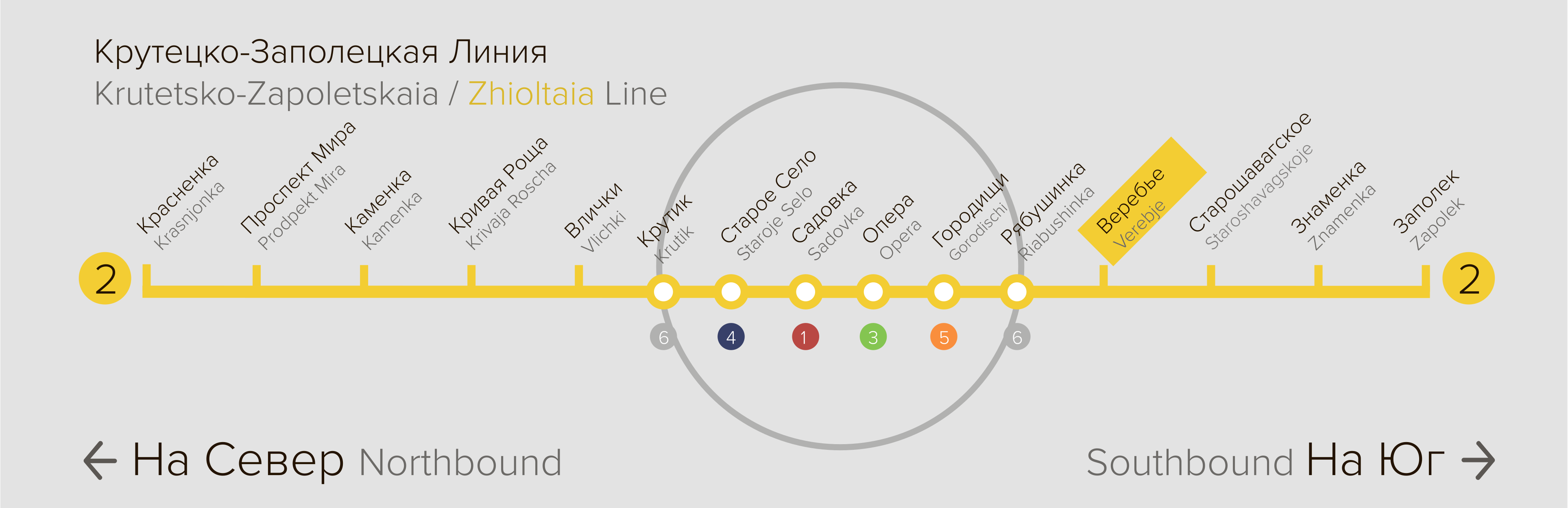
There was no understanding of line spacing and letter spacing, that transliteration of names should be secondary, and that it's important to choose a font not just for appearance but for legibility and functionality as it should be playfully considered to be a 'navigation' tool.
There was no understanding of systematically aligning objects or automatically calculating equal spacing between them. I was just learning the basics of composition in a new environment. Nevertheless, I was getting something right.
There was no understanding of systematically aligning objects or automatically calculating equal spacing between them. I was just learning the basics of composition in a new environment. Nevertheless, I was getting something right.
Above: A linear 'station' map for a metro line from one of the first versions of the map.
Below: The first complete application to the main map: the metro map.
Here they aren't related to each other (yellow line looks different), as the project was actively developing, and at some point I radically redesigned the route network. The omissions in some lines are due to the removal of personal names of people close to me, which I can't publish in my portfolio.
Below: The first complete application to the main map: the metro map.
Here they aren't related to each other (yellow line looks different), as the project was actively developing, and at some point I radically redesigned the route network. The omissions in some lines are due to the removal of personal names of people close to me, which I can't publish in my portfolio.
The old standards for producing transit maps in Russia, which I had been observing since childhood, always provided information for each depot separately. There was no concept of a unified city network of buses, trolleybuses and trams. There was a first and second tram depot, more than 15 bus depots and so on, and a separate map was drawn for each division. Trained by these principles, I drew a trolleybus route network for my city based on individual depots (10 routes each).
So far, the main impact was being achieved by the quantity of materials (and the free time spent on the work), rather than their quality.
So far, the main impact was being achieved by the quantity of materials (and the free time spent on the work), rather than their quality.
Below you can see a general view of four maps and one fragment, which can't be zoomed in due to the personal data in the stops' names. I didn't have the time to make maps for other modes of transport, so I... simply restarted the project.
Pay attention to special details: to offset the isolated nature of each depot map, I've indicated trolleybus routes from other depots passing through the same stop in grey circles next to the stop names, and to which transfers could be made there. It's a crude solution, but it seemed to be an option.
Pay attention to special details: to offset the isolated nature of each depot map, I've indicated trolleybus routes from other depots passing through the same stop in grey circles next to the stop names, and to which transfers could be made there. It's a crude solution, but it seemed to be an option.
Part Two
Vireives
2016
Vireives continues and develops the idea of Mestetsk project. The street grid has remained largely unchanged, but the transportation has evolved and expanded. I also changed some technical parameters, such as the artboard size. Working processes on the old computer became faster, although the remaining canvas was still immensely large.
I also gained some experience with software, sharpened my eye, and changed the technology for creating some graphic objects. The etymology of the new project's name is lost, I only remember that I managed to came up with it using Finno-Ugric roots of the name "Mstinsky Most", which is, as I already said above, a really existing village just in the center of my canvas.
Here, let's talk about the second appendix to the main map, which at this stage has reached its final form - the commuter train map. To ensure everything looked realistic, I studied the local railroad network with even those parts which were dismantled in real life, but remained suitable for my project (I encountered such cases during the paper-map period).
Guided by my perfectionism, I created four train terminals in the center of the city, named them after the cities to which the routes from them could lead (as it usually happened with such toponyms in European cities), and defined the commuter route zone.
Guided by my perfectionism, I created four train terminals in the center of the city, named them after the cities to which the routes from them could lead (as it usually happened with such toponyms in European cities), and defined the commuter route zone.
The railway connection to Moscow and St. Petersburg is clear: its presence was one of the key considerations in the city's site selection process from the very beginning. The other two terminals and routes, to Kaliningrad and Arkhangelsk, inevitably connected with the first pair of routes at the borderline of the emerging suburban zone.
In a strange way, it turned out that such cities and settlements as Okulovka, Malaya Vishera, Tikhvin, Kirishi, Borovichi, Chudovo, Tosno, Valdai and the entire regional capital, Veliky Novgorod (!), ended up in the imaginary agglomeration of my city.
In a strange way, it turned out that such cities and settlements as Okulovka, Malaya Vishera, Tikhvin, Kirishi, Borovichi, Chudovo, Tosno, Valdai and the entire regional capital, Veliky Novgorod (!), ended up in the imaginary agglomeration of my city.
All existing stations on the Moscow - St. Petersburg railway were transferred to my map. The demolished line to Verebye village was 'restored' in my project as a part of the inner city rail route.
Stations on the Kaliningrad/Novgorod and Arkhangelsk/Volkhovstroy routes are named after villages found along the imaginary routes of such 'railways'.
An alternative to innovation like Aeroexpress trains was also introduced. The closest airfields to the city (whether military or civilian) were found in the agglomeration, and imaginary railway lines were 'built' from them to the main railway routes. Krechevitsy (near Novgorod) and Lyubytino (east of the Mstinsky Most) became the two 'airports' for Vireives. Initially, there were two maps: one with directions (as it was in Moscow in 2000s) and one with routes (more similar to systems in Europe). I found the second one to be clearer, so it is shown below.
Stations on the Kaliningrad/Novgorod and Arkhangelsk/Volkhovstroy routes are named after villages found along the imaginary routes of such 'railways'.
An alternative to innovation like Aeroexpress trains was also introduced. The closest airfields to the city (whether military or civilian) were found in the agglomeration, and imaginary railway lines were 'built' from them to the main railway routes. Krechevitsy (near Novgorod) and Lyubytino (east of the Mstinsky Most) became the two 'airports' for Vireives. Initially, there were two maps: one with directions (as it was in Moscow in 2000s) and one with routes (more similar to systems in Europe). I found the second one to be clearer, so it is shown below.
A detail that seemed very logical and easy to understand at the time of its creation:
The commuter train route map was first created in 2016. The file later became partially damaged, and in 2024 the map was redrawn with minimal changes, mainly affecting the appearance of the legend. The remaining elements were left almost unchanged to reflect the vision of the concept at that time.
- express train routes are designated with circles,
- routes that stop everywhere - with squares
- semi-express trains, and routes that stop on selected stops only - with an ellipse, a middle form between a square and a circle.
The commuter train route map was first created in 2016. The file later became partially damaged, and in 2024 the map was redrawn with minimal changes, mainly affecting the appearance of the legend. The remaining elements were left almost unchanged to reflect the vision of the concept at that time.
Originally, it is a train service to the Moscow's Sheremetyevo and Domodedovo airports, which is still in use.
Finally, I attempted to create navigation signs for stops. These are perhaps the least meaningful pieces of work, as the intervals and most of the routes were plucked from the air and without any connection to the map, not least because the map included route info for trolleybuses only.
I also learned what mockup is and tried to see what my work looked like if everything was real. Looking from my today's set of skills and competencies, the design here is still quite poor, but it's still a remarkable milestone in the development of the entire project.
Part Three
Consientum
2017
If I'm so fascinated by transportation maps themselves, and the road network design phase takes up so much time, maybe I could make it without streets? This is how the idea of keeping a personal journal in the format of a city transportation map was born. It removes the limits for my imagination, especially such as characteristics of a proper chosen existing land for the imaginary city.
The mode of transportation showing in a new map becomes unimportant. I prefer to think that it is a light rail transit map, which can be expanded with appendixes, bus and trolleybus routes maps running between stations. In such a system, the opening of each new station is a big event, and this became an important point of the new concept.
The mode of transportation showing in a new map becomes unimportant. I prefer to think that it is a light rail transit map, which can be expanded with appendixes, bus and trolleybus routes maps running between stations. In such a system, the opening of each new station is a big event, and this became an important point of the new concept.
So, here's the principle. Each line represents certain part of my life: family, distant relatives, friends, acquaintances, teachers, mentors, tourist trips, concert outings. Each station represents, in the vast majority of cases, one person connected to a specific area. If they are connected to several areas at once, it becomes a transfer hub between certain lines, symbolising a very significant influence on my life. Transfer hubs can be formed for example in honour of those times when I shared a trip or went to a concert with someone. Hubs also can represent special cases when people from absolutely different parts of my life know each other without my help.
Still, there is an important limit for a layout city's location is coastal. This sets the vector for transit line growing only in two of four directions (toward the so-called 'north' and 'east' of the map), which appear as I meet new people or gain new experiences.
Still, there is an important limit for a layout city's location is coastal. This sets the vector for transit line growing only in two of four directions (toward the so-called 'north' and 'east' of the map), which appear as I meet new people or gain new experiences.
Version 1 (in German) and 3 (in Russian, both made in 2016). Only tram routes, no additions.
A total of exactly 200 maps were created from the project's inception till March 2026, many of them were made from scratch but inheriting the core elements.
The map version numbering began with the first version for Consientum project.
A total of exactly 200 maps were created from the project's inception till March 2026, many of them were made from scratch but inheriting the core elements.
The map version numbering began with the first version for Consientum project.
Time, chronology is a whole new dimension of the project. It defines another rule: the earlier I've known a particular person, the closer to city's center (coastline core) a station appears on the map. Quite often, we can see the same happening to real cities: the earlier the station built, the closer it is to historical center.
Another principle is about the station's opening date. I can assume, each station's opening can be associated with that time when I first met a person or spent some good time together. Stations honouring people I met at school or university group to different districts automatically, continuing the tradition of thematic zoning from the previous version of the project.
The number of ways to form new symbols and cyphers seems to be unlimited. For example, you can associate stations names with a person's occupation (or other characteristics), or try translating first and last names into other languages within the same context of associations.
Another principle is about the station's opening date. I can assume, each station's opening can be associated with that time when I first met a person or spent some good time together. Stations honouring people I met at school or university group to different districts automatically, continuing the tradition of thematic zoning from the previous version of the project.
The number of ways to form new symbols and cyphers seems to be unlimited. For example, you can associate stations names with a person's occupation (or other characteristics), or try translating first and last names into other languages within the same context of associations.
As you can see from the first example, the new chapter of the project was inspired by my passion for Central Europe, especially the German language. I don't know why, but the idea of a multilingual model will continue in the project, with alternative versions of maps in various languages. Now the system is translated in 13 languages besides Russian, including Hungarian, Greek, Georgian and Armenian. When I say 'translated' I mean a specific way to transit the meaning of the names and symbols they code, which is applicable to the Russian forms. I find ways of how the name could sound if it was established in a different cultural and linguistic area from the very beginning, having no Russian root, but holding the same definition.
I'll note that while it becomes more important to show all the details with each subsequent version of the project, sharing this part is much more difficult because all the names are now personalised. Here, with rare exceptions, I'm providing general view of the maps so that the layout is clear and the scope of the work is understandable. The new city is named Conscientum, from the Latin "de conscientia" - "of consciousness", because everything that happens on the page is locked in my mind.
I'll note that while it becomes more important to show all the details with each subsequent version of the project, sharing this part is much more difficult because all the names are now personalised. Here, with rare exceptions, I'm providing general view of the maps so that the layout is clear and the scope of the work is understandable. The new city is named Conscientum, from the Latin "de conscientia" - "of consciousness", because everything that happens on the page is locked in my mind.
Version 4 with additions (2016-2017).
Tram routes (key maps): day and night service, supplemented by trolleybus and bus routes on separate sheets.
Tram routes (key maps): day and night service, supplemented by trolleybus and bus routes on separate sheets.
The new idea distanced my work from classical transport planning and cartography, within which I saw alternatives for my personal development. Now it's all a collection of symbols, something that definitely doesn't exist, because there's no even a geographical basis; it's all like a computer game. I choose the line configurations myself, as well as the people and phenomena for the station names. The layout is a whole independent set of logical and geometry problems which is interesting to solve when it is all related personally to you. So, the field of graphic design itself became the main priority for me.
It's difficult, but not impossible, to find several similar projects online and I was quite surprised when I did. Funny, when I see it, I'm immediately repulsed by the idea; it seems boring to me due to its detachment from reality. However, I draw optimism and inspiration for my personal project from the fact that it's a prototype sandbox and a remarkable system where you simultaneously encrypt events for yourself and where you are free to change the rules without deviating from the essence.
Versions 9 & 14 (2018).
All three modes of transport are placed on a single sheet, with continuous route numbering.
Tram routes (line numbers 1-9) are the same lines symbolising various parts of life, while other routes (bus & trolleybus) complement them. The difference between them is barely noticeable from afar, which is one of the major drawbacks of these versions.
For bus and trolleybus lines even the route number can act as a special symbol.
The route grid remained virtually unchanged for several versions. Greenlands and other additional information about the 'area' appeared and disappeared in various versions.
All three modes of transport are placed on a single sheet, with continuous route numbering.
Tram routes (line numbers 1-9) are the same lines symbolising various parts of life, while other routes (bus & trolleybus) complement them. The difference between them is barely noticeable from afar, which is one of the major drawbacks of these versions.
For bus and trolleybus lines even the route number can act as a special symbol.
The route grid remained virtually unchanged for several versions. Greenlands and other additional information about the 'area' appeared and disappeared in various versions.
Designing transfer hubs is a highly detailed process that often requires seeking new solutions and constant improvement.
As mentioned above, I 'translated' the map into other languages.
For example, there are maps appeared at different times in Czech and Georgian. The latter is especially fascinating to look at without knowing the language and being accustomed to the symbols of the Georgian alphabet. The Georgian map technically belongs to the next chapter – it was created in 2021.
Some of the names were translated while preserving the phonetics of the Russian names, while others were translated completely, with the root word replaced with a foreign one.
Of course, it's all just a game when you don't know these languages, but you remain fascinated by them.
For example, there are maps appeared at different times in Czech and Georgian. The latter is especially fascinating to look at without knowing the language and being accustomed to the symbols of the Georgian alphabet. The Georgian map technically belongs to the next chapter – it was created in 2021.
Some of the names were translated while preserving the phonetics of the Russian names, while others were translated completely, with the root word replaced with a foreign one.
Of course, it's all just a game when you don't know these languages, but you remain fascinated by them.
Part Four
Peshi
Since 2019
Peshi is the most recent incarnation of the concept I'm describing. It's a veritable diary in the form of a transit map, which I now keep consciously. By keeping I mean adding stations to the map as I meet new people, creating new, beautiful symbols, and determining the locations for the stations.
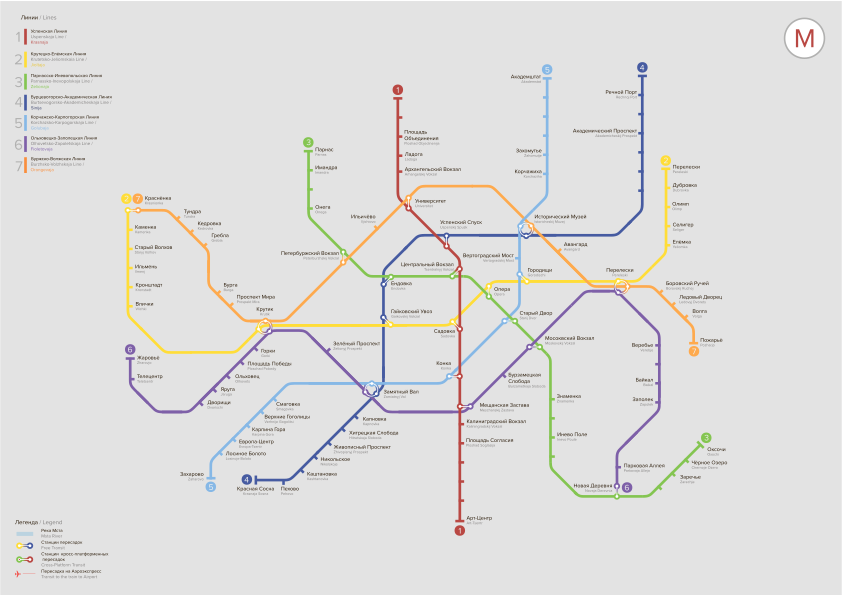
At this stage, it's worth evaluating the visualization. The concept hasn't changed fundamentally: the same light rail routes (tram or metro lines - it doesn't matter anymore); the main thing is what the stations are, how they encode the symbol in their names, and which lines they are on. Below are the key versions of the latest maps, in which the line layout has changed. And a few details.
At this stage, it's worth evaluating the visualization. The concept hasn't changed fundamentally: the same light rail routes (tram or metro lines - it doesn't matter anymore); the main thing is what the stations are, how they encode the symbol in their names, and which lines they are on. Below are the key versions of the latest maps, in which the line layout has changed. And a few details.
Versions 18.0, 19.0, 19.2, and their fragments
(2020-2024).
The major design breakthrough, starting with version 19.0.1, was the new angle grid —30, 60, 120, and 150 degrees.
(2020-2024).
The major design breakthrough, starting with version 19.0.1, was the new angle grid —30, 60, 120, and 150 degrees.
Here are a couple of examples of how I create a code or symbol for station names.
A friend of mine and I went to university together, but at first we were just distant acquaintances. A little later, she and a group of friends went to Georgia, where we got to know each other better and became truly close friends. For this example, you could translate the word "friend" into Georgia - shekvarebuli - and name the station after her. This is much more interesting than simply naming the station after friend's name.
Another example is a station named after a history teacher from my school, whom I greatly respected. It's more interesting, though rather obvious, to name the station after her not by her name, but by a landmark that might be located in the city, such as the Historical Museum. Following the same pattern, 'Botanical Gardens', 'Hospitals', and so on appear on the map in honour of teachers or friends' occupations and lifestyles.
There are also examples of names, as it is said in Russian, in honour of the people who are "widely known in narrow circles" - nicknames, abbreviated names, and simply local Easter eggs. The result is a hodgepodge, a compote, or a mishmash - choose your favorite word.
A friend of mine and I went to university together, but at first we were just distant acquaintances. A little later, she and a group of friends went to Georgia, where we got to know each other better and became truly close friends. For this example, you could translate the word "friend" into Georgia - shekvarebuli - and name the station after her. This is much more interesting than simply naming the station after friend's name.
Another example is a station named after a history teacher from my school, whom I greatly respected. It's more interesting, though rather obvious, to name the station after her not by her name, but by a landmark that might be located in the city, such as the Historical Museum. Following the same pattern, 'Botanical Gardens', 'Hospitals', and so on appear on the map in honour of teachers or friends' occupations and lifestyles.
There are also examples of names, as it is said in Russian, in honour of the people who are "widely known in narrow circles" - nicknames, abbreviated names, and simply local Easter eggs. The result is a hodgepodge, a compote, or a mishmash - choose your favorite word.
